
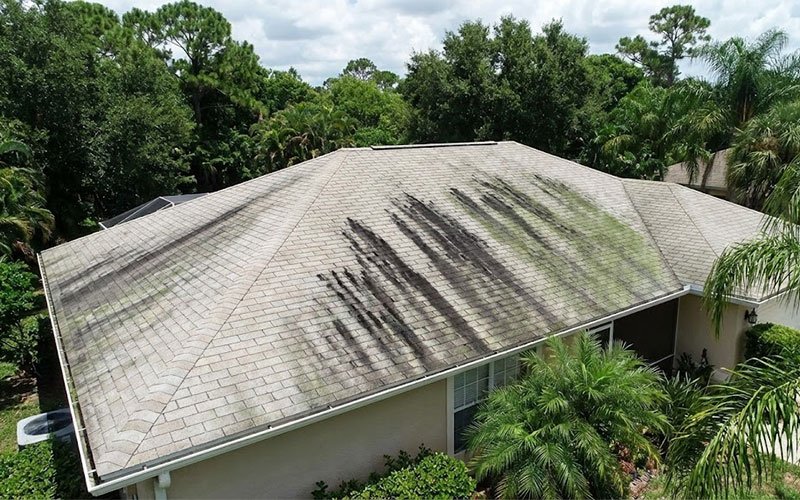
Have you looked up at your roof recently and noticed dark, vertical streaks running down your shingles? You aren’t alone. In the humid climate of Bluffton and Hilton Head, this is one of the most common complaints we hear from homeowners.
Many people assume it is just dirt, soot, or tree sap. Others worry it is black mold.
The truth? It’s actually a plant. And yes, it is eating your roof.
At New River Roofing, we believe in educating our neighbors. Here is exactly what is growing on your shingles and how to handle it safely.
1. Meet “Gloeocapsa Magma”
Those black streaks are actually a form of blue-green algae called Gloeocapsa magma.
This airborne bacteria thrives in warm, moist environments—making the Lowcountry a perfect breeding ground. The reason it loves your roof is simple: it feeds on the crushed limestone filler used in modern asphalt shingles.
2. Is It Just Cosmetic, or Is It Dangerous?
While the primary issue is ugly curb appeal, algae is not harmless.
- Heat Absorption: The black streaks cover the reflective granules on your shingles. This causes your roof to absorb more heat, forcing your air conditioner to work harder during our scorching South Carolina summers.
- HOA Violations: In strict communities like Sun City or Palmetto Bluff, a dirty-looking roof can quickly lead to a violation notice from your HOA.
- Long-Term Decay: Over time, as the algae eats away at the limestone, it can weaken the structural integrity of the shingle, causing it to lose its protective granules prematurely.
3. Warning Signs: Algae vs. Granule Loss
It is critical to distinguish between a dirty roof and a dying roof.
- Algae: Usually appears as streaks, often on the north-facing side of the roof (which gets less sun and stays damp longer). The shingles are still intact underneath.
- Granule Loss: If you see “bald spots” where the black asphalt is showing through, or if you find piles of ceramic sand in your gutters, that isn’t algae. That is a sign your roof is near the end of its life and needs replacement.
4. The “Do Not Pressure Wash” Rule
If you have algae, your first instinct might be to grab a pressure washer. Do not do this.
Blasting your roof with high pressure will strip the granules off your shingles instantly, voiding your warranty and ruining the roof. Algae must be treated with a professional “soft wash” chemical solution that kills the spores without damaging the shingles.
5. The Permanent Fix
If your roof is older and the algae is widespread, cleaning might only be a temporary fix. When you replace your roof with New River Roofing, we install modern shingles featuring “StainGuard” protection—copper-infused granules that prevent algae from growing in the first place.
New River Roofing LLC
Protecting Bluffton & The Lowcountry
Address: 20 Towne Dr. Ste 295, Bluffton, SC 29910
Phone: +1 843-707-6516
Website: https://newriverroofingsc.com/